There was a time when we used to read dystopian fiction as if it was a crystal ball that could reveal potential pitfalls of a future gone wrong. There are the classics like George Orwell’s 1984, Aldous Huxley’s Brave New World and Philip K. Dick’s Do Androids Dream of Electric Sheep, as well as newer examples such as Suzanne Collins’ The Hunger Games and Veronica Roth’s Divergent series. There are also numerous examples from Hollywood, television and videogames, e.g. The Matrix, The Walking Dead, Horizon Zero Dawn, etc.
The word dystopia is a combination of dys (bad) and utopia (an imaginary island that has achieved perfection in all things). Dystopia therefore would be the opposite of utopia, an imaginary place that has somehow gone as wrong as can be. It was first used by a Victorain philospher, John Stuart Mills, in 1868. Both utopia and dystopia should therefore be impossible places, as Sir Thomas More, the author of Utopia (1516) intended (the word literally means ‘no where’. However, there is evidence that we have achieved the impossible and are currently living in a dystopian world.
There are different types of dystopia, bureacratic, corportate, philosophical, techological, etc., that mainly feature some form of corrupt government or entity that has taken control and brought about disastrous or undesirable conditions. The slogan of “War is Peace, Freedom is Slavery, Ignorance is Strength” from Orwell’s 1984 captures the bleakness of a totalitarian state and introduces the world to the idea of double speak. The horror of it is that this kind of double speak is replete in modern politics, quite often being prefaced with the politicians’ favourite opening words, “It is right …” Freedom of speech is weilded like the whip in the hands of the master race, brought out to punish those who would speak against the hegemonic values of the countries that hold veto powers in the UN Security Council. Freedom of speech therefore has become the preserve of the powerful, to be used against the weak.
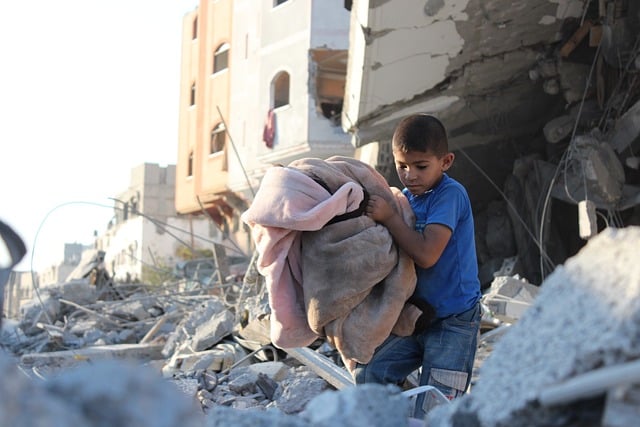
Governments are making decisions in the name of their people but often out of step and against the will of their people. The past decade has seen a sharp increase in conflicts and civilian deaths (World Bank Group, 2016). Wars are quite often fought in areas that are densley populated and result in the destruction of both private and public poverty, loss of life (quite often women and children, something that has been starkly noted in the Israel/Palestine conflict with the latest death toll at 27,513, of which 11,600 are children and 8000 women). Developed countries are reaping the rewards of war profiteering, whilst war torn countries free fall into poverty and destitution. The World Food Programme (2023) estimate that “as many as 783 million people are facing chronic hunger”, with conflict being cited as the biggest driver for hunger, following by climate crisis and increase in food prices.
Dystopian fiction, be it in print, film or video game, is meant to serve as a mirror for us to look into and make adjustments. Its meant to show us that despite increasingly bleak circumstances that there is still hope. There are people in Gaza, Ukraine, Yemen, Syria, Sudan, Ethioia, the Sahel, Myanmar, Haiti and Armenia-Azerbaijan that are currently facing conflict, famine, poverty and disease who are looking to the rest of the world for a solution. We are calling for ceasefires, donating monies for relief and acting as witnesses to their suffering. However, we need to do more. We need to hold our politicians to account. We need to hold the corporations who are profitting from this misery to account. We have become weak but we are not yet toothless. Write to your political representatives, take part in protests, sign petitions, donate generously and boycott war profiteerers.
Discover more from NOOR A JAHANGIR
Subscribe to get the latest posts sent to your email.

