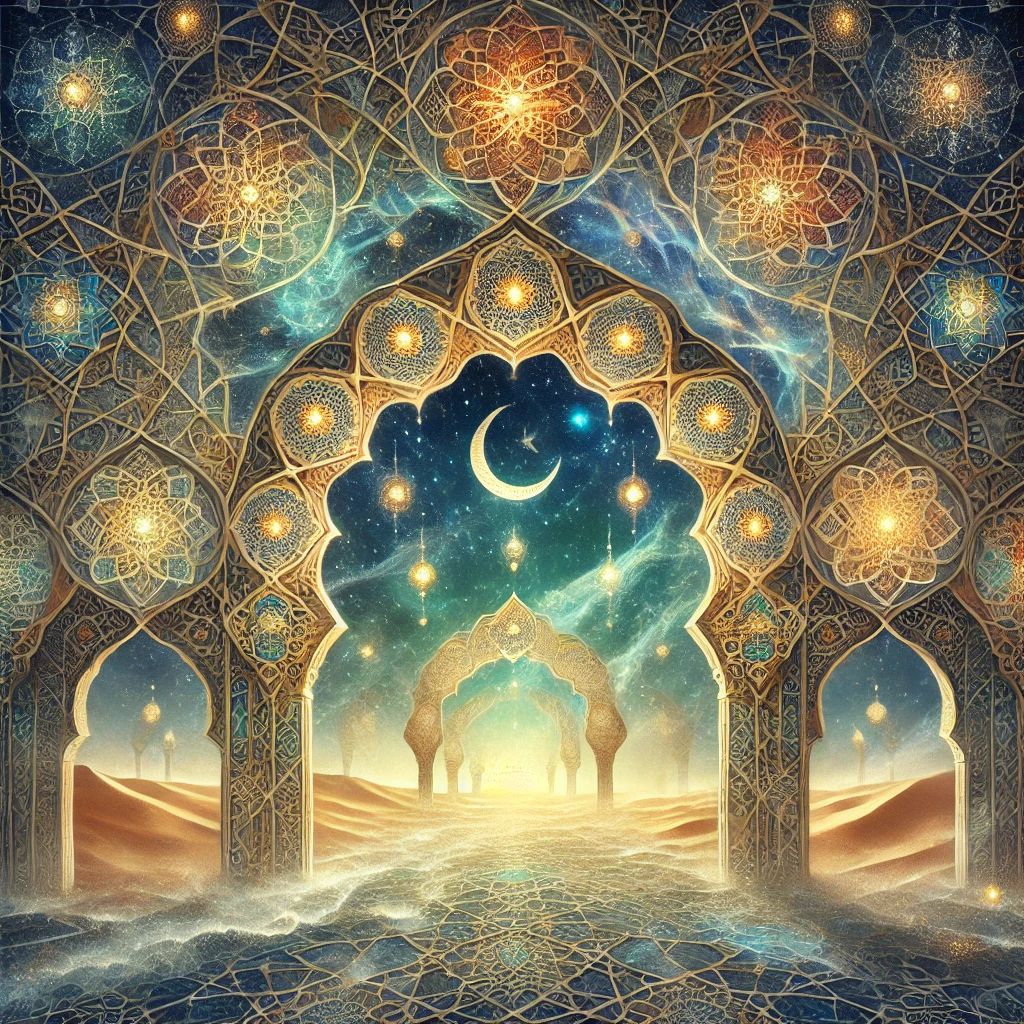
The mind stills. The body relaxes. The spirit rises up, tethered to its mortal shell with a gossamer tendril. Free to wander the spiritual realm but tentatively connected to the physical world. The aim is to lose oneself in the awe of the Almighty.
In my last post, I looked at the bestiary available to writers of Muslim fiction. In today’s post, I’d like to explore the worlds that set apart Muslim fantasy from standard Western fantasy. I want to focus especially on the hidden realms. These include: Jannah (paradise), Jahanum (Hell), Barzakh (purgatory), and the realm of the Unseen.
Contextually, Muslim fantasy could be based anywhere in the world. Contemporary fantasy/sf could be located in the Muslim diaspora of the West. It explores themes of liminality, prejudice, displacement, and travel. It could be set in any part of the world. The story can explore the unique struggles of Muslims currently. They are experiencing persecution in places like Gaza, Kashmir, Myanmar, Xinjiang, or Syria. G. Willow Wilson’s Alif the Unseen is based in some modern Middle-Eastern country that has experienced colonialism and is currently being controlled by a despotic ruler with his secret police. Chakraborty’s Daevabad Trilogy starts off in less contemporary Cairo and then swiftly moves into the Middle-Eastern realm of the djinn. Islamic history spans over 1446 years and covers a lot of geography, from China to Texas, from Mongolia to South Africa. Therefore, there are plenty of times and places that can be explored. The travels of Ibn Battuta and Ibn Jubayr are good sources of information to explore a particular time in history
In terms of the spiritual realm, there is a place where the unborn souls reside, where the souls are constantly engaged in the rememberance of their creator. There is a place under the lote tree. All the children who have died spend time there in the company of the Prophet Ibrahim (Abraham), peace and blessings be upon him. There is also where the good souls reside after death, and welcome members of their family newly arrived in death. There is also a place for the bad souls too. Each is a reflection of the ultimate destination, Heaven or Hell.
In The Changeling King, I briefly explored a fictional Mughal kingdom that had its own geopolitical issues going. This fictional kingdom is situated close to Rajasthan, within sight of the Bengal mountains. The land is lushly forested, full of natural resources and in a strategically important location. The East India Company had established a foothold in Hindustan and was causing ripples in the political and economical landscape. In the planned sequel, The Vagabond Prince (Working Title), Sultan has been cast far from Kryllon. Throughout the novel, he wanders the world of Eridani. He looks for somewhere that may spark a memory, a sense of familiarity, and a place to call home. I have another book idea based in a fantastical version of Pakistan. It features another journey that takes the characters through plains, mountains, deserts, and rocky valleys. The world and world-building in general almost act as a character in itself. They provide much of the texture and shape to the overall story.
If you have started writing or are considering writing Muslim fiction, drop a message in the comments, and let’s start a conversation.
Discover more from NOOR A JAHANGIR
Subscribe to get the latest posts sent to your email.


I bet a Taliban fantasy would be the eradication of all women and girls.
Hi Vala, that would certainly be counterproductive. It sounds more like a counter radical-feminist trope, eradication or complete submission of men, and the patriarchy. I don’t speak for the Taliban or all men, however, as a Muslim, I respect and value the women in my life. My mother, my wife, my daughter, my sisters and my nieces. I also encourage that women recieve all their God given rights, in their homes, in their earnings and in their inheritance.