The Hajj is annual pilgrimage that draws nearly 2 million people every year and has been the literal mecca for pilgrims since the time of Ibrahim (Abraham), peace and blessings be upon him, which is some 4000 years.
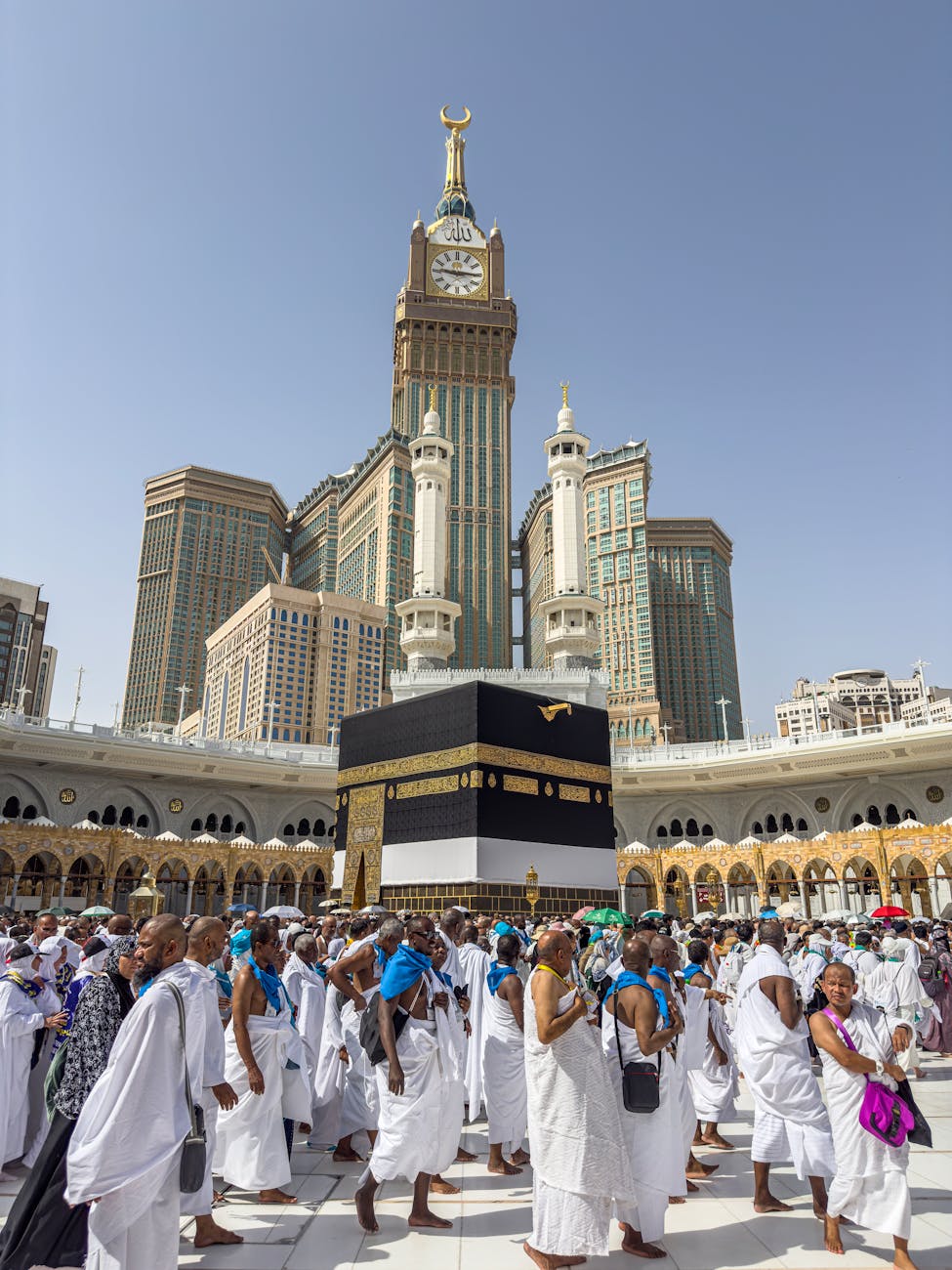
In this post, I will share with you 5 things you may or may not know about the Hajj.
The Hajj is one of the five pillars of Islam, which are:
- The Shahadah: bearing witness to the Oneness of God and that Muhammad is His Servant and Messenger.
- Salah: To pray five times daily
- Saum: To fast during the month of Ramadan
- Zakat: To give a compulsory charity to Muslims in need
- Hajj: To perform the pilgrimage to Makkah (Mecca) at least once in your lifetime
1. What is the Hajj
The Hajj takes place in the 12th month of the Islamic lunar calendar (Dhil Hijjah) which has begun as of Wednesday 28th May 2025. Every Muslim who is physically and financially able to at least once in their life. They have to be sound of mind and body, financially able to afford the Hajj. In the UK, packages range from £4500 to £9000. Elsewhere, it can cost between $3000 to $11,000, depending on the level of convenience and luxury you are after and where you are traveling from. You also need to have enough money to sustain your defendants. If you are never in the situation where you are both physically and financially able to perform the Hajj, then the obligation is lifted from you on your passing.
2. A Journey of Faith
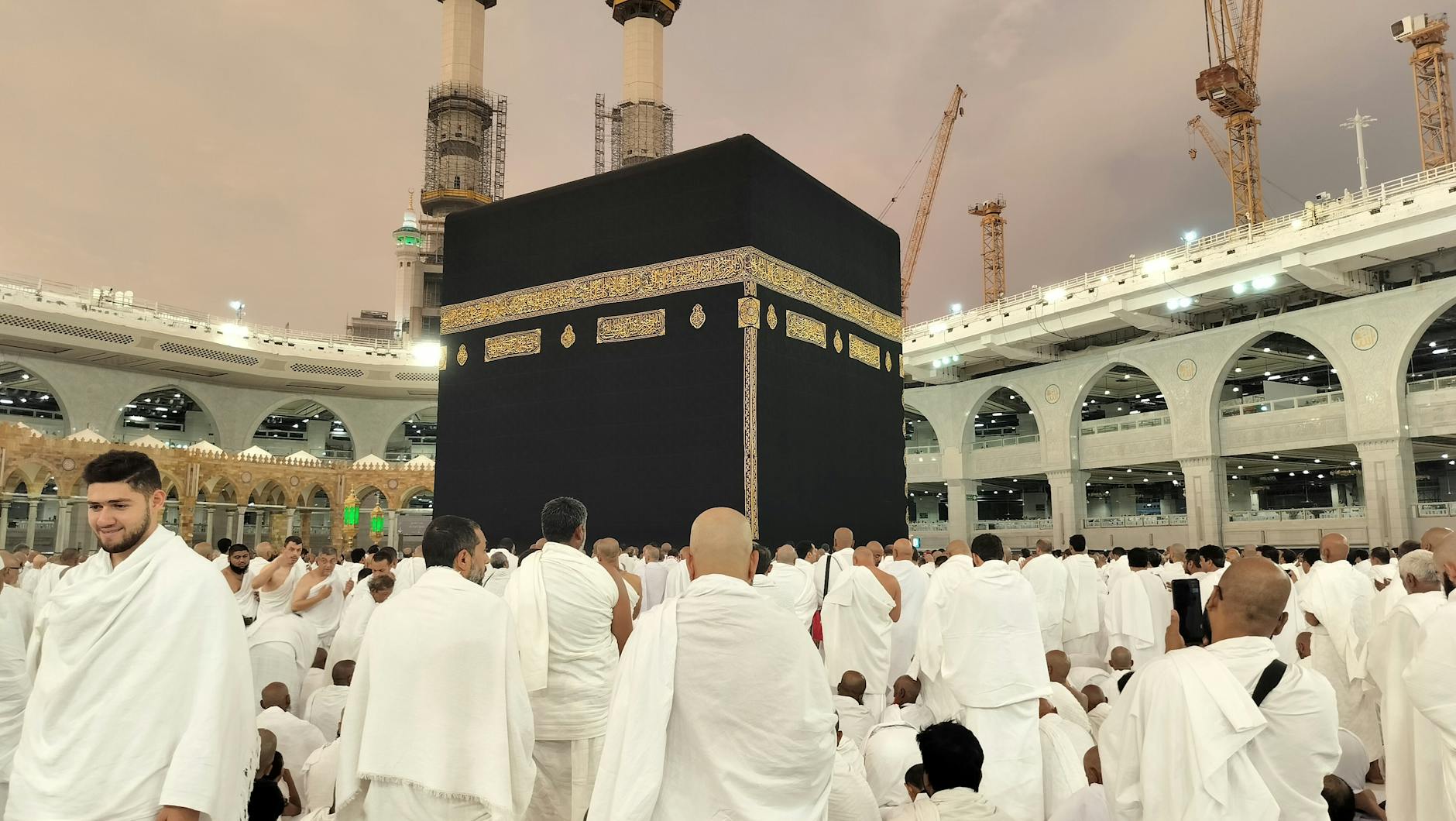
I did my Hajj in 2003, the year after I graduated and got my first proper job. What I remember of the journey is that it was both physically and spiritually taxing. Men have to dress in simple robes, known as the ihram, essentially to pieces of cloth, one to wrap around your waste (no boxers allowed) and one to drape over you shoulder. Women are allowed to wear simple but stitched clothing. The feet, hands and face must be uncovered (cloth can’t touch your face). Flip-flops (sliders) do good business in the run up to Hajj. Even if you are staying at a nice hotel, there is a lot of walking to do. When I did it, I was about 17 stones and my thighs were chaffing a lot (shout out to petroleum jelly for keeping me sane). The physical is tough, but at the same time it was spiritually demanding too. I mean, you are literally walking around the House of God, built 4000 years ago by Ibrahim and Ismael (Ishmael), peace and blessing be upon them both.
3. Historical Roots
The whole journey of the Hajj mirrors the journey of the family of Ibrahim (peace and blessings be upon him and his family). Ibrahim (peace and blessings be upon him) was commanded by God to travel with his wife Hajrah (Hagar) and their toddler (Ismail) to the deserts of Arabia. There he was commanded to leave them both in a valley and not to speak to them. When Hajrah (the pilgrimage is literally named after her) saw Ibrahim leaving, she called out to him ‘Why are you abandoning us?’ Ibrahim stopped but did not turn around. ‘Did God command you to do this?’ Ibrahim nodded. Seeing this she said, ‘Then He will not neglect us’. This is a true mark of strength. Not only did her words grant her reassurance but also helped her strengthen her husband’s resolve. So Hajrah and Ismael stayed in the desert (during the Hajj, pilgrims have to stay in a number of places, in Mina, in Arafah and in Muzdalifah). There is a narration in a Hadith (tradition of the Prophet Muhammad), narrated by Ibn Abbas, that relates what happened next.
’Ismail’s mother went on suckling Ismail and drinking from the water. When the water in the water-skin had all been used up, she became thirsty and her child also became thirsty. She started looking at him tossing in agony – and she left him, for she could not endure looking at him. She found that the mountain of As-Safa was the nearest mountain to her on that land. She stood on it and started looking at the valley keenly so that she might see somebody, but she could not see anybody. Then she descended from As-Safa and when she reached the valley, she tucked up her robe and ran in the valley like a person in distress and trouble, until she crossed the valley and reached the Al-Marwa mountain, where she stood and started looking, expecting to see somebody, but she could not see anybody’. (Ibn-Kathir)
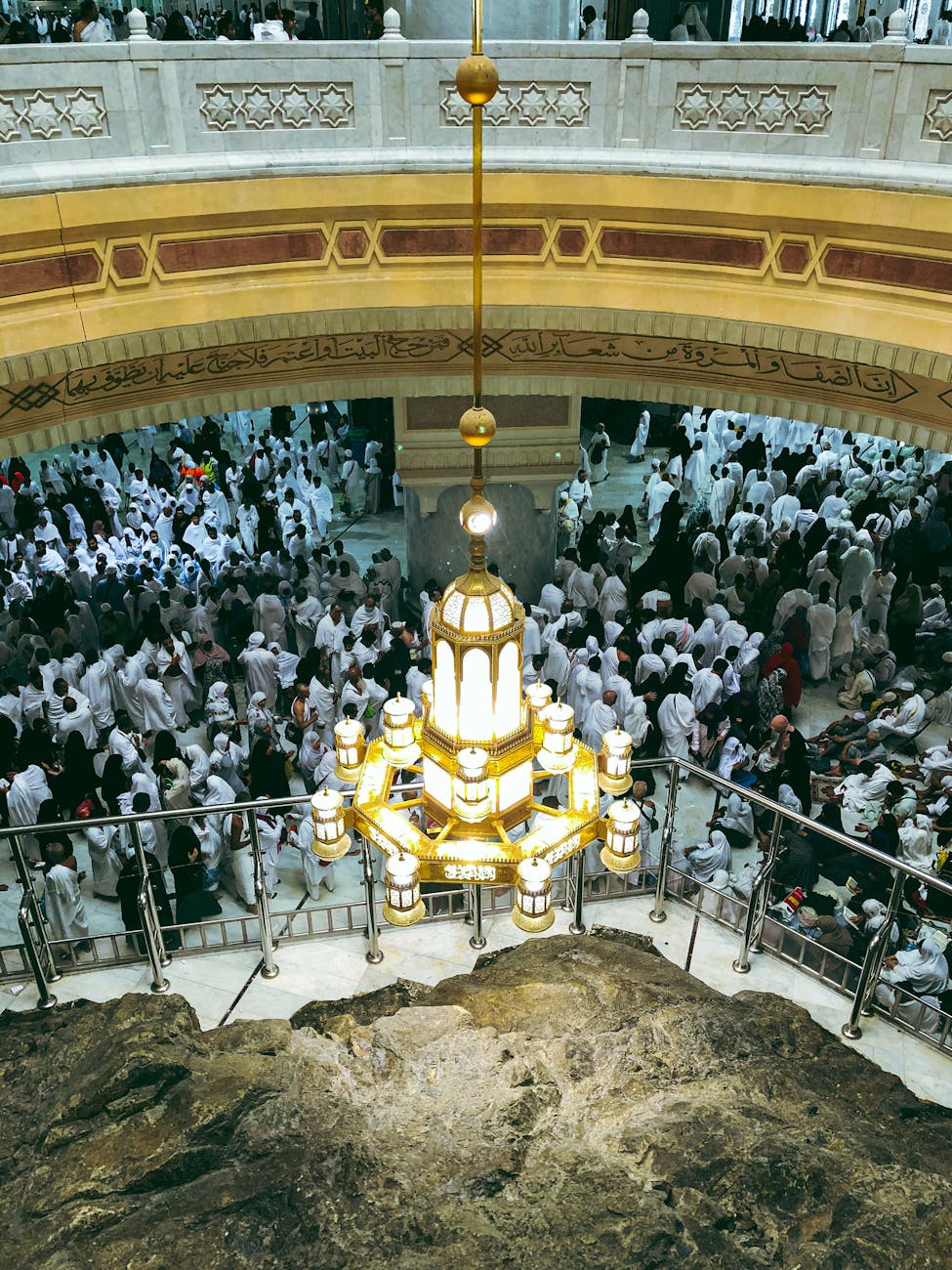
Hajrah ran. She ran between the two mountains 7 times (something which became mandated as part of the Hajj). Whilst standing on Al-Marwa, she heard a voice. She called out and heard the voice. She then saw an angel standing near Ismael. She ran down the mountain and saw the angel (Jibrail, or Gabriel) dig his heal into the earth. Water began to flow from the spot. She raced across the valley and began to form a basin of earth around it. She filled her water-skin but the water continued to flow. Legend has it that she called out ‘Zome, zome’, stop, stop, which is how the name ZamZam came about.
Ibn Kathir writes that the Angel said to her ‘Don’t be afraid being neglected, for this is the House of Allah which will be built by this boy and his father, and Allah never neglects his people’.
People from the Banu Jurhum, a Yemeni tribe, found their way to the valley, having seen a bird circling the source of water. The interesting thing about the Zamzam is that it is the only source of potable water for miles around. Everywhere else in the desert the water is brackish. The people sought permission from Hajrah to settle there and she allowed it with the condition that they would not take possession of the well. These people settled in what was at the time known as Bakkah, and from them Ismael learned the Arabic language. Later, Ismail married a woman from this tribe and became the progenitor of the Banu Hashim, the tribe which the Prophet Muhammad was born into.
4. The Core Rituals
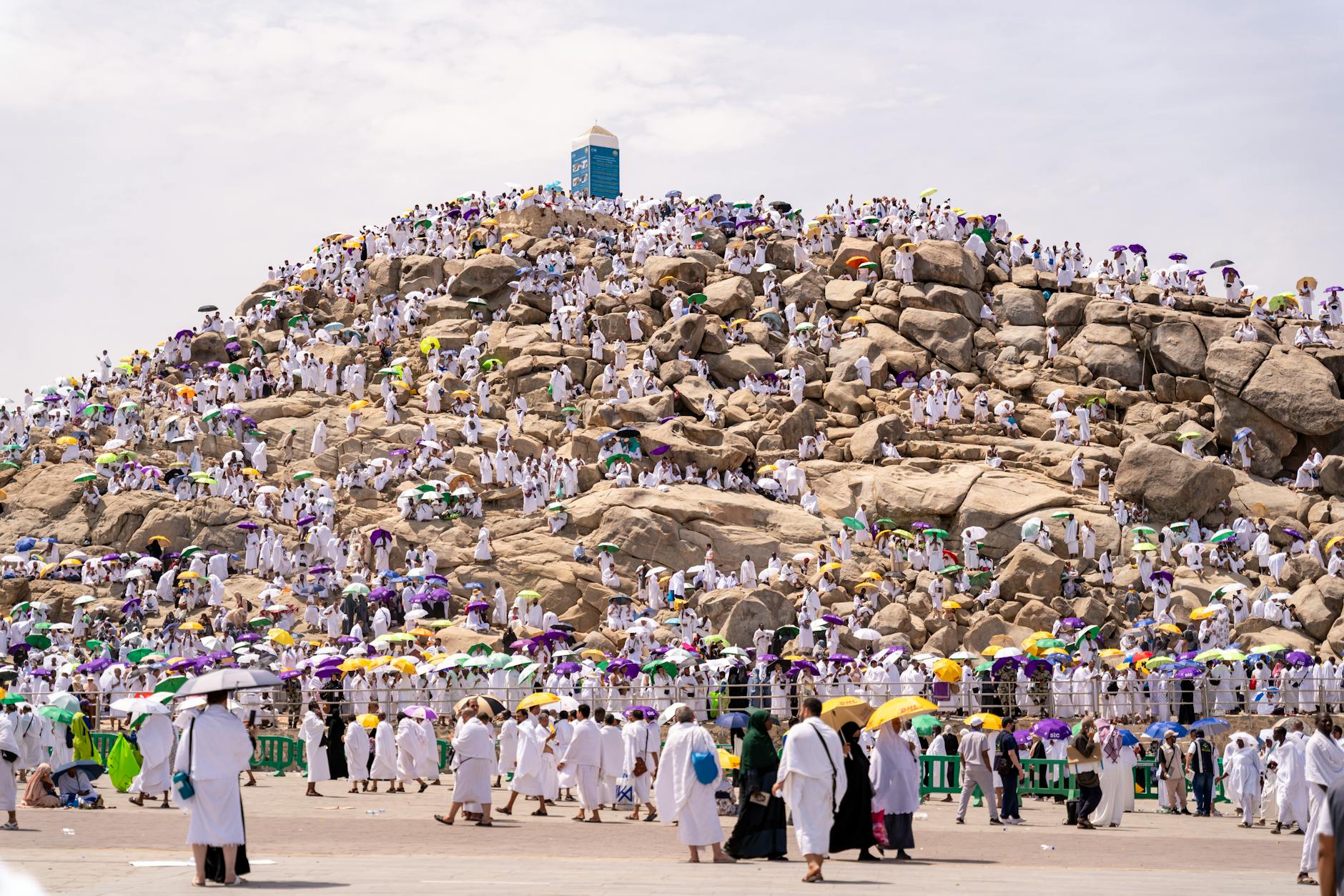
The visual that everyone associates with the Hajj is the Tawaf, circling around the Kaaba, which was built by Ibrahim and Ismail (peace and blessings be upon them). This is followed by the Sa’I, waling and at times running up and down Safa and Marwa. The mountains have now been incorporated into the Holy Mosque, so it is much easier for pilgrims to complete the seven laps of the two mountains than what Hajrah (may the Lord’s Mercy be upon her) endured. Pilgrims are also encouraged to drink their fill from the water of Zamzam. The well has now been moved underground. There is also a small monument named Maqam-e-Ibrahim, which translates as The Place of Ibrahim, a gold, latticed cage set around a rock that has the footprints of Ibrahim imprinted in it. It is recommended to observe optional prayers near this spot. Another core ritual that takes place a little later is to spend the day in Arafah (a flat plain where all people will be gathered on Day of Resurrection). And there is the stoning of the pillars in Mina, known as Rami-ul-jamarat. It is a symbolic action that mimics what Ibrahim (peace and blessings be upon him) did on his way to sacrifice his son (we’ll come back to that).
5. The Days of Hajj
On the 8th of Dhul Hijjah, after performing the tawaf and Sa’I, pilgrims will travel to Mina before the afternoon prayer. They will spend a night in the tent city of Mina. The tents are semi-permanent and there are toilet and shower blocks interspersed throughout the city. Each section is designated by nationality.
On the 9th, pilgrims leave Mina after the morning prayer and head to Arafat. Arafat is about 20km from Makkah and is a large open plain. There are more temporary tents here, but people tend to spend the time in reflection and repentance. The pilgrims stay in Arafat until sunset. Then they trek to Muzdalifah, a more rocky and less hospitable plain. They perform their sunset (maghrib) and night prayer here and sleep out in the open. They also gather pebbles from the ground to use for the stoning of the devil the next day. There are coaches organised for taking the pilgrims from site to site, but many opt to walk. During my Hajj, we walked from Arafat to Muzdalifah. We rested there and then continued on to Mina on foot, breathing in the fumes and dust kicked up by the passing coaches.
On the 10th, pilgrims head back to Mina and pray the morning prayer there. Then its on to the Jamarat, the stone pillars, to stone the devil. The story behind this is that God commanded Ibrahim to sacrifice his son, Ismael, through repeated dreams. When he told his wife and son, they agree that this was a command from God and he must complete it. Heavy of heart, the father and son set off from Mina to carry out the command. Along the way, Satan appeared near the a stone heap and tried to dissuade Ibrahim. Ibrahim, encouraged by the angel Jibril, responded by throwing seven stones at him. He then appeared again at a second stone heap and once more Ibrahim pelted him again on the advice of Jibril. This was again repeated at the third heap. This is why, during the pilgrimage, Muslims stone the pillars that have been erected to mark each spot where the devil tried to stop Ibrahim from acting on God’s Will. On the 10th of Dhul Hijah, the pilgrims stone the third pillar and then go onto to commemorate the act of sacrifice. When Ibrahim reached the designated spot, he asked his son to lay down. Ismael said to him to allow him to turn his face away so that it would be easier for Ibrahim. He also asked that his father bury him in this location and not to return his body to his mother, as it would be hard on her. However, as Ibrahim raised his knife, something took hold of his hand and he was unable to complete the act. The words of the Quran describes the moment:
“And We called out to him: ‘O Ibrahim. You have fulfilled the vision.’ Indeed, We thus reward the virtuous.” (Quran, 37:104-105). “And we ransomed him with a great sacrifice.” (Quran, 37:107).
Ismael was ransomed with a ram. Thus the sacrifice of an animal is also part of the rituals of the Hajj. Once the sacrifice is made, the pilgrims shave their heads (women clip their hair), bath and are allowed to put on their normal clothes. Some people elect to return to Makkah and perform another circling of the Kaa’ba, pray near the place of Ibrahim and drink ZamZam, before returning to Mina. Everywhere else in the world, Muslims will be sacrificing an animal and celebrating Eid-ul-Adha (The Celebration of the Sacrifice). Mostly, these days, it is done through charities that distribute the meat to the most needy in the world.
On the 11th of Dhul Hijjah, after the afternoon prayer, the pilgrims will return to stone the devil, and this time will stone all three pillars, before returning to their tents in Mina.
On the 12th, pilgrims once again stone the three pillars and then leave Mina before sunset. Pilgrims return to Makkah to perform the farewell visit, Tawaf-ul-Widah, to the Kaa’ba. This completes the Hajj. After the Hajj, people often travel to Madinah, to visit the Prophet’s Mosque and offer salutations at his grave and visit some of the historical sites nearby.

So there you have it, 5 things, about one of the 5 pillars of Islam, focusing on the 5 days of Hajj. If you enjoyed this post or found it informative, please consider subscribing. If you want to support my writing, consider buying one of my books or buy me a coffee by using the link.

Discover more from NOOR A JAHANGIR
Subscribe to get the latest posts sent to your email.

